
The major trail running events sector faces a major environmental challenge: the carbon footprint generated by participant mobility. UTMB Group offers a structural response to this issue through its Travel Policy, a mechanism combining behavioral incentives, mandatory contributions, and the deployment of concrete logistics solutions. This ambitious and reproducible approach has been nominated in the Environmental Initiative of the Year category at the Trail Running Awards.
Mobility at the core of the carbon footprint
The initiative is based on a clear analysis: the majority of the carbon impact of an international event like UTMB comes from the travel of runners, partners, and teams.
The Travel Policy was developed to tackle this challenge head-on by acting on four fundamental levers, in close collaboration with Protect Our Winters (POW) and local authorities.
The four pillars of the policy:
Data collection: Each participant declares their mode of transport and place of residence, allowing for a precise calculation of the carbon footprint for each journey.
Behavioral incentives: Runners who opt for lower-carbon travel, depending on available options, benefit from a significant bonus in the registration lottery.
Carbon contribution: All stakeholders (runners, partners, organization) contribute financially in proportion to their emissions, with funds reinvested into carbon capture or avoidance projects via a certified organization.
Concrete logistics support: Deployment of active solutions to facilitate behavioral change.
Innovation: Incentives, transparency, and collective commitment
The Travel Policy stands out for its blend of technical rigor and behavioral innovation.
A unique incentive model
The bonus system is an innovative feature in trail running at this organizational scale. By linking transport choices to increased registration odds (via the lottery), UTMB leverages its primary draw to actively encourage more sustainable practices.
Deployed logistics solutions
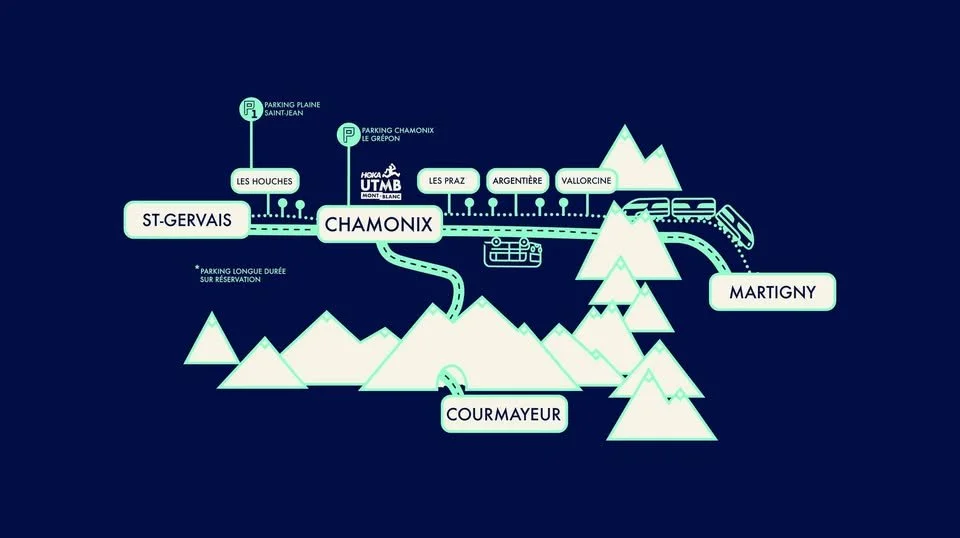
Financial commitment translates into substantial investments in sustainable mobility: the establishment of numerous UTMB Mobility bus lines, the establishment of rail partnerships (TGV Lyria) and regional bus services (Alpybus) to offer preferential rates. Furthermore, the UTMB GO platform (developed with You.Smart.Thing) provides a decision-support tool to plan the lowest-emission journeys.
Transparency and reproducibility
The approach is overseen by a partnership with the NGO Protect Our Winters (POW) to ensure that every decision is ethically and technically justified. UTMB commits to total transparency through the annual publication of carbon results and quantified reduction targets. Designed to be scalable and replicable by other international events, this model aims to serve the entire industry.
Impact and institutional validation
Initial results from the Travel Policy demonstrate concrete effectiveness, with several thousand cars avoided during the previous edition. The plan is accompanied by a commitment to reduce emissions for coming years and significant annual investments in sustainable mobility.
This initiative enjoys the institutional support of Mont-Blanc communities, including the Municipality of Chamonix. The Mayor of Chamonix-Mont-Blanc, Éric Fournier, emphasizes that sustainable mobility is a "necessity" for the valley and that the event "must continue working together to protect our mountain environment." This collaboration with local authorities and athletes (via PTRA) confirms the collective approach and the relevance of the system.
By tackling the primary environmental challenge of outdoor sports head-on, the UTMB Travel Policy establishes itself as a model for environmental policy applied on an international scale.
